There are rounds of golf you remember because you played well.
And then there are rounds you remember because you stepped into a different century.
Our day at Leonardville Golf Club in Kansas, a sand-green course, was the latter.
The “Green” That Isn’t Green
At first glance, the course looked like classic Midwestern golf — wide skies, gentle rolls, mature trees scattered across open land. But as we approached the first putting surface, it became clear this was something entirely different.
The “greens” were 20-foot diameter circles of sand mixed with oil or other binding agents to keep it firm and cohesive. Instead of mowing and watering turf, superintendents drag and bind the sand. No bentgrass. No Bermuda. No grain to read. Just a carefully maintained, tightly packed very small disc of sand surrounding the flagstick.
Instead of a putter-only finish, this was a full-contact operation.

The Posted Rules at Leonardville Golf Club.

The Typical Putting Surface and Collar at Leonardville Golf Club
Once your ball reached the putting surface, the ritual began.
Roll Your Own Line
Behind each green stood a painted blue steel pole holding three tools: a very heavy roller, an equally heavy rake and a small cup used to remove water from the hole or to put sand around the cups edge.
After marking your ball, you removed the roller and quite literally rolled a putting path to the hole. The roller compressed the sand into a smooth strip, creating a temporary “green” — your personal runway to the cup.
The path lasted only as long as your turn.
The putt itself required conviction. No delicate dying speed here. You had to hit it firmly — decisively — to carry the ball across the compacted sand and into the hole. Leave it short and it simply stopped.
There’s something oddly satisfying about that. No three-foot tricklers. No lip-outs from timid strokes. Commit or live with the consequences.
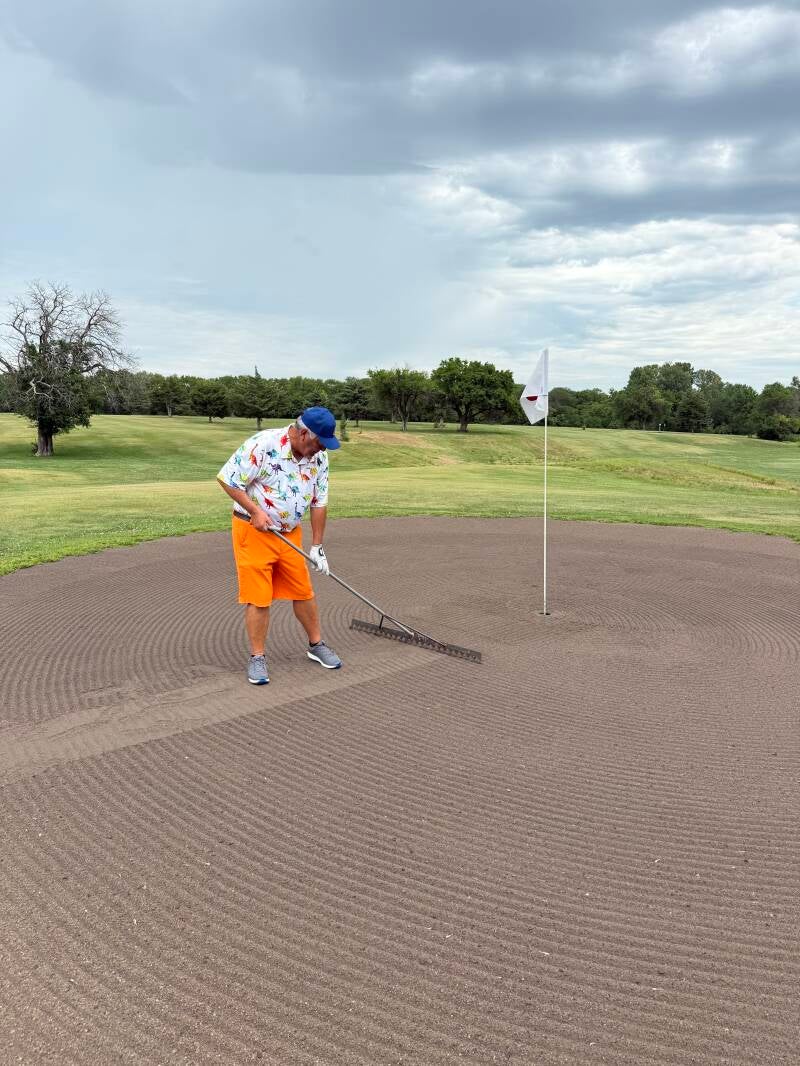
After holing out, the final act: return the roller, take the rake, and restore the green to pristine symmetry for the next group.
It’s etiquette and agronomy rolled into one.

Tools of the Trade -- every hole comes with its own set
Time on the Putting Surface
The time spent on each “green” was substantial. Marking your ball. Removing the roller. Rolling your path. Judging firmness. Putting. Replacing the roller. Removing the rake. Raking the entire surface smooth.
It turned the act of finishing a hole into a process — almost ceremonial.
Pace of play? Let’s just say you don’t sprint around a sand-green course. But you don’t want to. The rhythm slows you down in a good way.
It forces you to be present.

Every player rolls their own line -- then hits the putt with authority
The finishing touch -- raking the green for the next group
A Vanishing Chapter of American Golf
Sand greens weren’t always a curiosity. In fact, at their peak in the early to mid-20th century, there were several thousand sand-green courses across the United States — particularly throughout the Great Plains, Texas, Oklahoma, Kansas, Nebraska, as well as north in the Dakotas and Wyoming and Colorado. They were also in parts of the rural South.
Grass greens require water, irrigation infrastructure, and maintenance budgets that many small towns simply didn’t have. Sand was practical. Durable. Affordable. And surprisingly playable.
Today? Estimates vary, but industry historians believe fewer than 75–100 sand-green courses remain in the entire United States — and the number continues to decline.
Kansas still holds one of the highest concentrations. There is only one left in Texas, a few in Oklahoma and the Dakotas. Each year, a few quietly convert to grass — or close altogether.
Which makes a round like this less a novelty and more of a preservation effort.

A 183 yard par 3 -- and yes, you're hitting to a 20 foot circle of sand
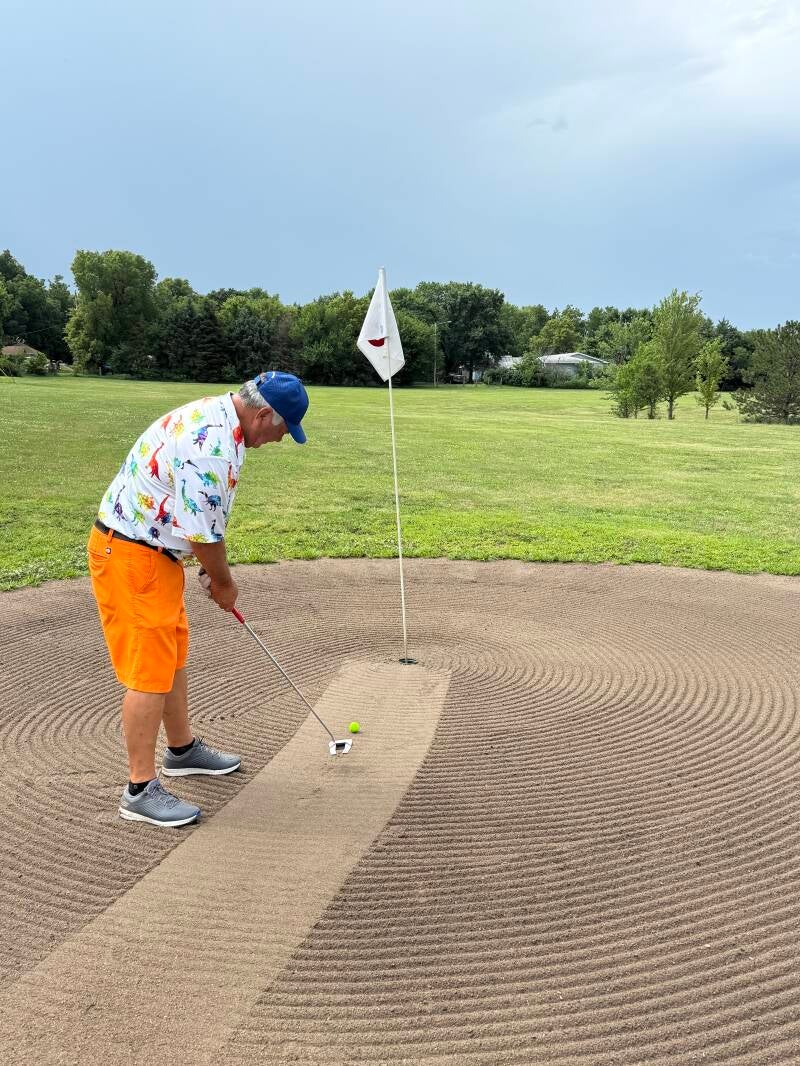
No Deceleration Allowed. Hit it past the Hole!
The Experience
There’s no Stimpmeter reading to debate.
No complaints about spike marks.
No arguments about whether someone repaired a pitch mark.
Instead, you have heavy steel tools, packed sand, and a system that has worked for nearly a century. Nine holes takes a long time.
It’s not polished country-club golf.
It’s frontier golf.
And standing on those perfectly raked concentric circles of sand — with a wide Kansas sky overhead — you realize something:
Golf doesn’t need to be manicured to be meaningful.
Sometimes it just needs a flag, a hole, a little creativity… and the willingness to roll your own path.
5 Things Sand Greens Teach You About Putting
- Deceleration Is Not an Option
There are no “dying it at the hole” putts on sand greens. If you baby it, the ball stops halfway down your beautifully rolled runway and looks at you like, really? That’s all you’ve got? Commitment isn’t encouraged — it’s required.
- You’re Responsible for Your Own Line
On a traditional green, you blame spike marks, grain, or a mysterious wobble. On a sand green? You literally rolled the line yourself. If it breaks offline, that’s on you, architect.
- Pace of Play Is a State of Mind
Mark. Remove roller. Roll path. Replace roller. Putt. Remove rake. Rake entire surface. Replace rake.
You don’t hurry through that process. Sand greens teach patience — and maybe a little calf endurance.
- There’s No Such Thing as a “Gimme”
When you’ve gone through the entire ceremonial production of rolling a path, you’re finishing it out. Three-footer? Yes, you’re putting it. You earned it.
- The Green Is Perfect — Every Time
No ball marks. No spike scars. No debates about who fixed what. When you rake it smooth, the surface is flawless for the next group. It might be the only putting surface in golf that is literally reset to zero after every hole.

Have you ever played on Sand Greens? If so, comment below and tell me about your experience!
Add comment
Comments