I played golf recently with a group of 16 guys ranging in age from 50 to 80. In that group were Billy Clagett, John Hendricks, Chuck Kuhlman, and David Dunnam — four men who have all shot their age, and in some cases do it often enough to make the rest of us a little uncomfortable. Watching that happen got me thinking about one of golf’s most intriguing milestones.
Shooting your age is one of those feats that gets talked about with a certain reverence, usually over drinks after the round. Stay healthy, keep teeing it up, get into your 70s, and maybe one day the stars line up. But when you stop and think about it, shooting your age isn’t some ceremonial gift that arrives with a Medicare card. It’s still a heck of a round of golf.
I haven’t done it yet, gross or net. Net is easier, of course, but only slightly. A couple of weeks ago I shot 69 gross and 65 net, missing the net version by about a month. Gross? I’ve never really been close. Maybe in a couple of years. Maybe. The good news is that, unlike a lot of golf goals, this one actually gets a little easier with every birthday.
Being a statistician by profession — and because I apparently can’t leave well enough alone — I decided to see just how realistic the chase really is.
A Feat With a Little History
According to golf lore, the youngest golfer generally credited with shooting his age was Bob Hamilton, winner of the 1944 PGA Championship, who shot 59 at age 59 in 1975. At the other end of the spectrum was Arthur Thompson of Victoria, British Columbia, who reportedly shot his age of 103 at Uplands Golf Club in 1972.
That’s part of what makes the feat so appealing. It can belong to a former PGA champion in his 50s or a 103-year-old still getting the ball around. Few golf accomplishments stretch across generations quite like that.
My Own Numbers
I’ve kept my scores and golf stats for years, and from 2008 through 2023 I logged almost 2,300 rounds. Over that stretch, my scoring average was 78.6, with a standard deviation of 3.6. In plain English, most of my rounds land in a fairly predictable range around that number, with the occasional day where everything clicks and the occasional day where golf reminds me that I’m not nearly as smart as I think I am.


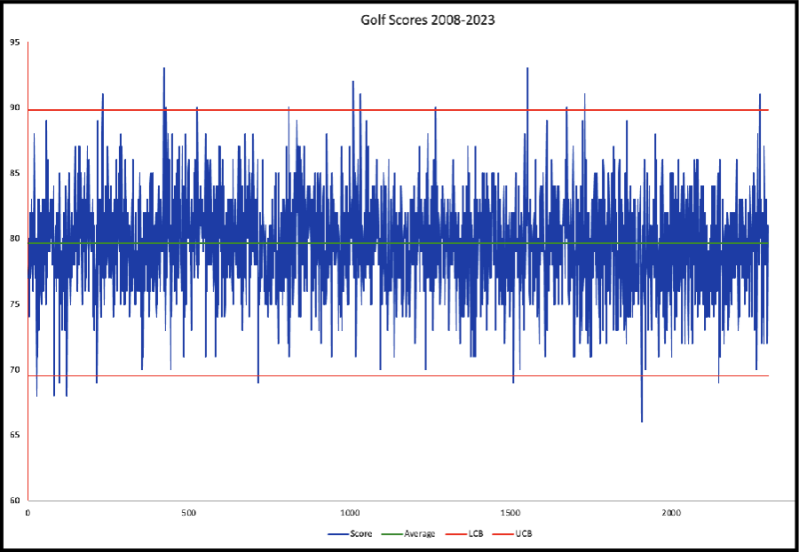
If you assume scores are roughly normally distributed — close enough for golf-blog purposes — then the probability of shooting your age in a given round can be estimated by:
P(Score ≤ Age) = Φ((Age − μ) / σ)
where:
- μ is average score
- σ is the standard deviation of scores
- Φ is the cumulative distribution function of the standard normal distribution, otherwise known as the bell curve I spent too much of my professional life around
Once you have μ and σ, the rest is simple enough: as your age rises and your target score gets larger, the odds improve.
A Broader Look: What About Other Golfers?
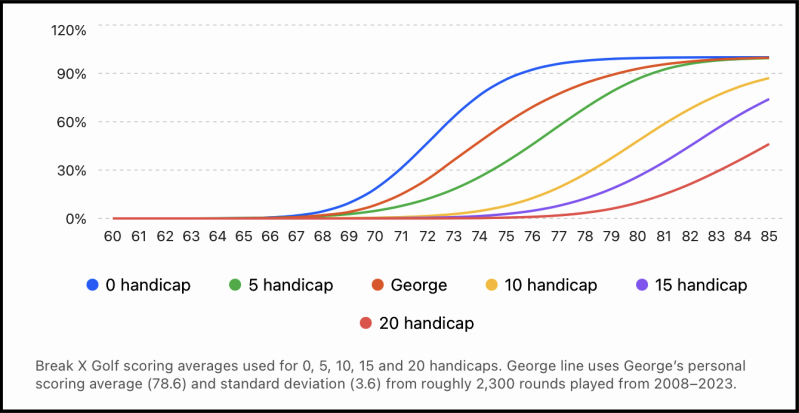
My own data tells me something about my chances, but I also wanted to know how this looks for golfers at different skill levels. For that, I used published scoring averages from Break X Golf for golfers ranging from scratch to 20 handicap, then paired those averages with handicap-specific scoring variability. That gave me a set of curves showing how the odds of shooting your age change from age 60 to 85 for several different kinds of players.
The results were both encouraging and sobering.
A scratch golfer has a real chance relatively early. By the low 70s, shooting your age isn’t a miracle — it’s a legitimate possibility. By the mid-70s, it becomes more likely than not.
A 5 handicapper — the group closest to my own game — has a steeper climb. The odds don’t really get interesting until the mid-70s, and even then there’s a big difference between “possible” and “something you should expect to do regularly.”
A 10 handicapper doesn’t really get into coin-flip territory until around age 80. A 15 handicapper is more of an early-80s story. And a 20 handicapper still has a mountain to climb even then.
Where I Fit
The interesting part for me was plotting my own scoring line against those handicap curves.
Because my average over those 2,300 rounds is 78.6, my curve sits a little better than the generic 5-handicap line from the Break X data. That makes sense. Averages matter, but consistency matters too. My standard deviation of 3.6 is tighter than the broader 5-handicap estimate, which means my “George line” starts climbing faster once I get into range.
In this model, I become roughly a 50/50 proposition in my mid-70s and have a very good chance by the time I reach the upper 70s.
Now, before anybody starts penciling in a 74 for me next week, let’s be clear: that doesn’t mean it’s about to happen. It just means the math has finally stopped laughing.
The Part the Math Can’t Quite Capture
Of course, there’s another variable here that my little bell-curve model doesn’t fully capture: how good the player was in his prime.
Billy, John, Chuck, and David don’t shoot their age because the target score has finally drifted into range. They shoot it because they were killers long before age started helping. Billy was medalist at the U.S. Senior Amateur qualifier with what was then a record score, won a stack of Austin and Central Texas amateur titles, and has the 10th hole at Lions Municipal named for him. John qualified for the U.S. Senior Open in Des Moines. Chuck won our club championship. David, once a +3.5 handicap, won all over the Texas Panhandle.
So when those guys shoot their age now, it doesn’t feel like some senior-golf novelty. It feels like the natural continuation of a lifetime of very good golf.
The Second Chart: How Many Rounds Would It Take?
One way to make the probabilities feel more real is to turn them into something every golfer understands: rounds.
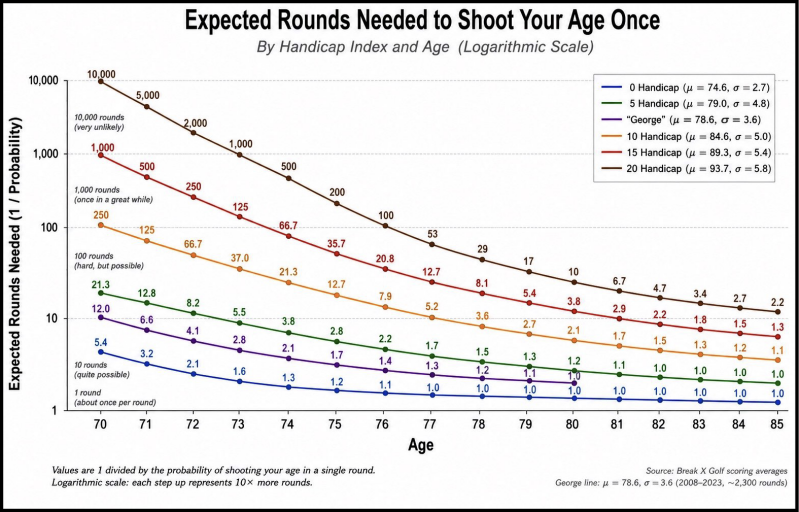
If you have a 25% chance of shooting your age, you’d expect to do it about once every four rounds. If your chance is 10%, it’s roughly once every ten rounds. If your chance is 2%, now we’re talking about once every fifty rounds, which feels a lot more like “possible in theory” than “likely this month.”
That second chart may be the most revealing one in the whole exercise. For a scratch player in his mid-70s, shooting his age is not some once-a-year miracle. For a golfer like me in my mid-70s, it becomes something you might reasonably expect to pull off if you keep teeing it up often enough. For a 15- or 20-handicapper, the required number of rounds stays stubbornly high until age does a lot more of the heavy lifting.
So What Did I Learn?
First, shooting your age is hard — harder than the casual storytelling around it sometimes suggests.
Second, it gets a whole lot easier if you were a really good player to begin with. The guys I know who do it regularly are not random senior golfers catching lightning in a bottle. They’re accomplished players who built that foundation years ago and now have the benefit of a more forgiving target.
And third, I’m not out of the picture yet.
I may not have had much chance to do it at 68 or 69, but the probabilities improve every year. The graph suggests that if I stay healthy, keep the handicap in the neighborhood, and continue making enough putts to avoid complete embarrassment, shooting my age is not some fantasy reserved for other people. It may simply be a milestone waiting for the calendar to cooperate.
Golf doesn’t offer many goals that become more attainable as you get older. We stop chasing 300-yard drives. We move up a tee box or two. A 480-yard par five becomes a three-shot hole instead of a challenge to our masculinity. But shooting your age is different. It’s one of the few golf dreams that actually gets a little closer every birthday.
So I’ll keep chasing it.
Maybe it happens net first. Maybe gross comes later. Maybe one day I catch a calm morning, make a few putts, avoid the big number, and finally turn one of those near misses into the real thing. I’ve already had the 69 gross and the 65 net. The score is somewhere in there.
I just need to hang around long enough to meet it.
Add comment
Comments
My closest was a 71 at Lakecliff when I was 70. I played with Pete League a few years ago and he tells me he shoots his age a couple of times a month. I think I'll need a pretty spectacular round at this point.
Hey George, thanks for the recognition. Not so sure it’s all that deserved. Some days on the links always humble you back into reality. 🤣🤣🤣
Interesting article George. Thank you