Golfers hit thousands of shots they forget almost immediately. A few remain perfectly preserved.
I have made five holes-in-one so far—and “so far” is important because there is always hope for another. I can still remember the club, the flight of the ball and the moment each one disappeared. My first came in Colorado when I was 16. My most recent came 41 years later in Texas. Between them were three more swings that transformed otherwise ordinary rounds into stories I will always be able to tell.
Every hole-in-one requires a good shot, but it also requires something golfers spend their lives trying unsuccessfully to control: luck.
What Are the Odds?
The odds depend on the golfer, the length of the hole and conditions such as wind, elevation, green size and hole location. Commonly cited estimates put the chance of a hole-in-one on a 150-yard par 3 at approximately 1 in 1,500 for a Tour professional, 1 in 5,000 for a 5-handicap golfer and somewhere around 1 in 12,500 for the average player.
Those odds help explain why every ace is special. They do not explain why one golfer makes five in a year while another, perhaps an even better player, waits 30 or 50 years for his first.
An ace is a fickle thing.
No. 1: The Found Slazenger
My first came in 1978 on the 14th hole at City Park Municipal Golf Course in Pueblo, Colorado, now known as Elmwood Golf Course.
The scorecard listed the hole at 154 yards, but the tees were moved back and a back-left hole location stretched it closer to 165 that day. I was 16 years old and hit a 7-iron.
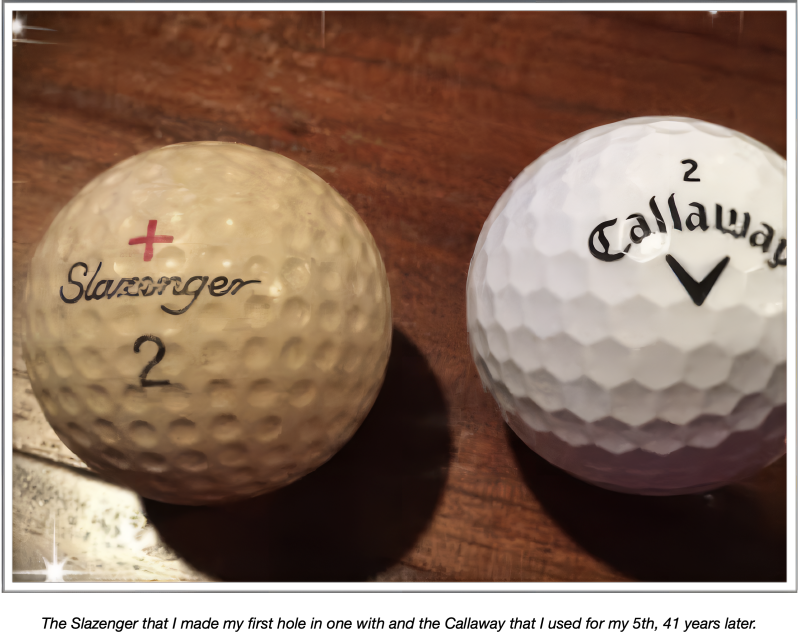
The ball was a Slazenger I had found. At the time, I thought of it as a “British ball,” made even more interesting because Slazenger was the brand James Bond played. I put a red cross above the logo so I could identify it.
Then I used it to make my first hole-in-one.
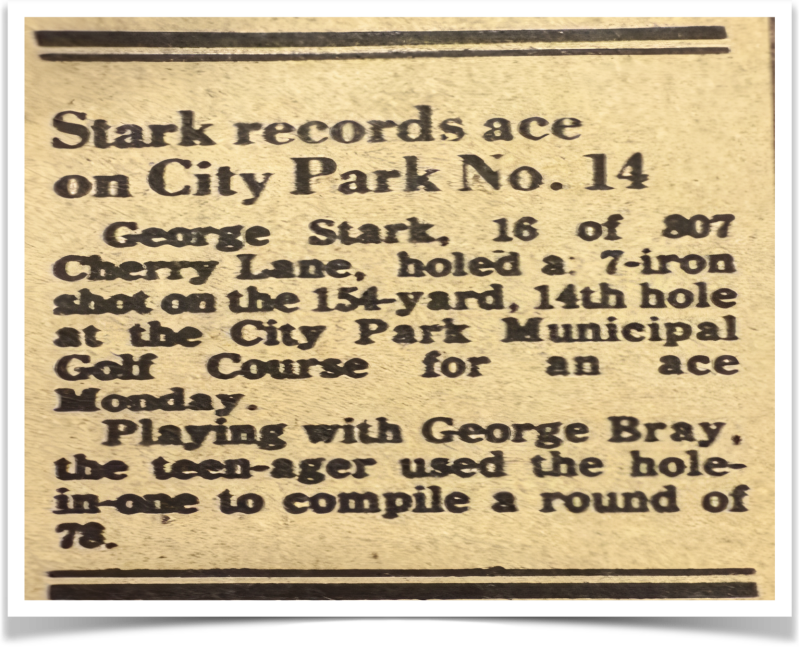
A small newspaper clipping recorded the essentials: “Stark records ace on City Park No. 14.” It identified me as George Stark, age 16, noted the 7-iron and reported that I was playing with George Bray. I used the ace to shoot 78.
I still have the clipping, and I still have the ball. It has yellowed considerably over the years, but the red cross and Slazenger name remain visible.
At 16, I’m not sure I fully appreciated how rare the shot was. Perhaps I assumed this was something that would happen every few years.
For a while, it almost did.
No. 2: Back Home from College
My second came a few years later, in the summer of 1980, when I returned to Pueblo after my first year of college in Fort Collins.
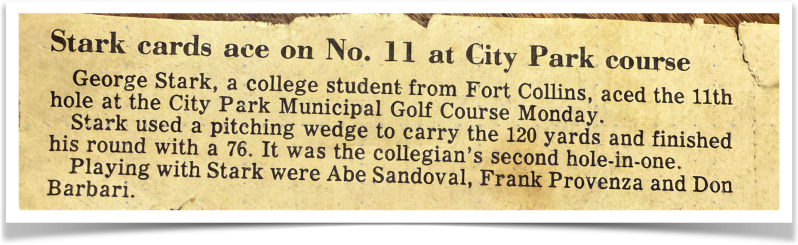
Once again, I was playing City Park, but this time the ace came on the 11th hole. It measured 120 yards, and I used a pitching wedge. I finished the round with a 76.
Not long ago, my sister sent me the newspaper clipping. Evidently, she had kept it in a scrapbook since we were growing up. The story listed my playing partners—Abe Sandoval, Frank Provenza and Don Barbari—and described me simply as “a college student from Fort Collins.”
That yellowed clipping outlasted the golf ball and many of my specific memories from the day. It also reminded me how families preserved moments before phones and social media documented everything. Someone clipped the story from the newspaper, put it into a scrapbook and kept it safe for more than four decades.

No. 3: A Summer at Kmart
By July 1982, I was a junior at Colorado State and spending the summer working in the automotive department at Kmart in Fort Collins. Somewhere between selling oil, batteries and whatever else came through the department, I found time to play Collindale Golf Course.
The 17th hole measured 151 yards that day. I hit an 8-iron with a Titleist DT and made my third hole-in-one.
I no longer have that golf ball. Somewhere along the way, it disappeared. But I have never lost the picture of the shot in my memory.
Golf memories are funny that way. Physical souvenirs can vanish during a move or get misplaced in a box, while a ball flying toward a flag more than 40 years ago remains perfectly visible.
Three aces before I had finished college seemed like a pretty good start. Surely there would be plenty more.
Then golf reminded me that it operates on its own schedule....
No. 4: Twenty-Three Years Later
More than two decades passed before No. 4 arrived in the summer of 2005.
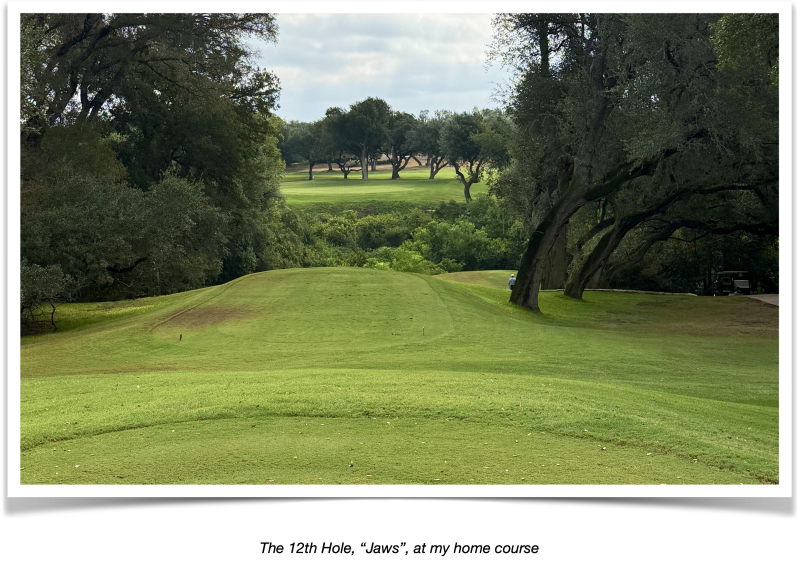
It came on “Jaws,” the 190-yard par-3 at Live Oak Golf Course in Lakeway, Texas. It was the longest hole I had ever aced and remains the longest of my five.
I was playing with my buddy Mike Scully and a new member at the club who served as a judge for the City of Westlake. I hit a 5-iron and watched the ball land, take one hop and disappear into the cup.
There is something particularly satisfying about making an ace on a hole called Jaws. The name suggests danger, intimidation and the possibility of losing something. For one one swing, however, Jaws was surprisingly generous.
After making three holes-in-one in a relatively short period as a young golfer, I had waited approximately 23 years for another. That long gap taught me more about their rarity than the first three ever could.
Then another 14 years passed.
No. 5: One More in Texas
My most recent ace came on February 9, 2019, on the seventh hole at Yaupon Golf Course in Lakeway.
The hole measured 177 yards. Once again, I used a 5-iron, this time with a Callaway ball.
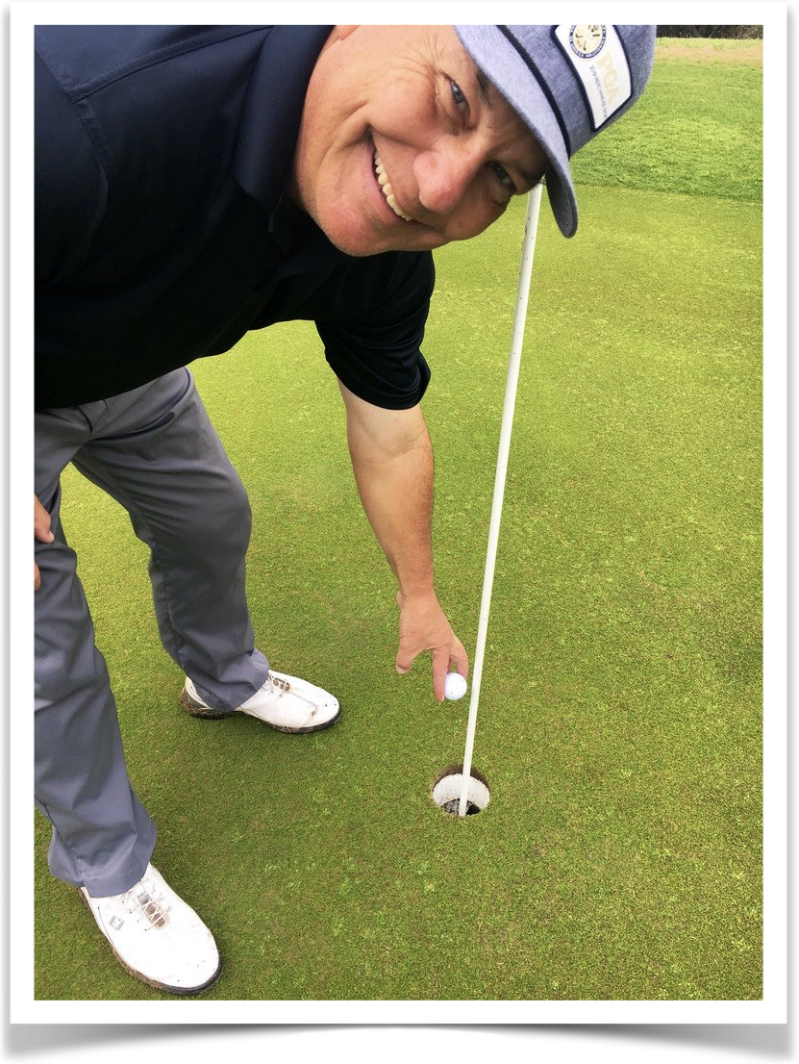
My playing partner, Mike Ius, took a photograph as I leaned over the cup to retrieve it. The picture captured the real moment: the flagstick still in the hole, the ball coming out of the cup and a fairly large smile on my face.
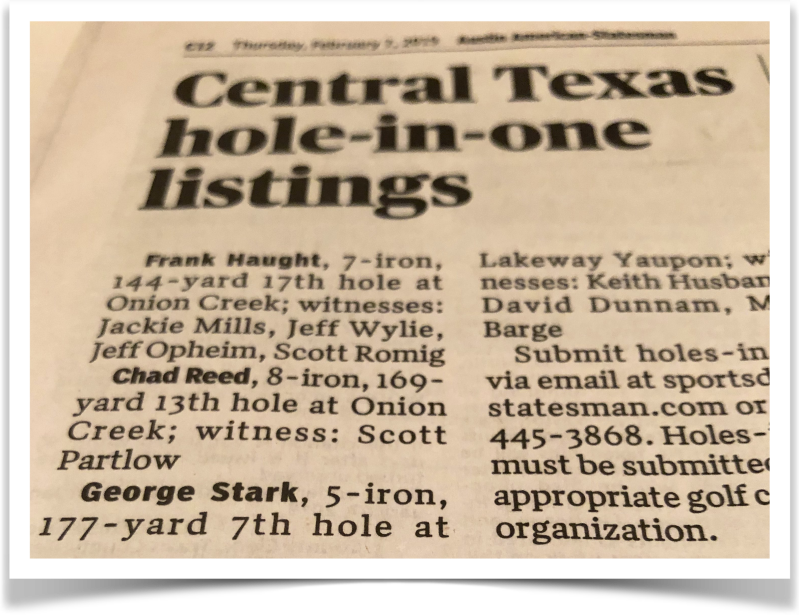
The ace was also recorded in the *Austin American-Statesman’s* Central Texas hole-in-one listings. Like the newspaper accounts of my first two, it reduced the moment to its basic facts: George Stark, 5-iron, 177-yard seventh hole at Lakeway Yaupon.
The listing was brief. The memory is not.
Two Golf Balls, 41 Years Apart
I still have the Slazenger from my first ace and the Callaway from my fifth. They now sit side by side.
The Slazenger is discolored and clearly belongs to another era. The Callaway looks almost new by comparison. Forty-one years separate those two balls, along with thousands of rounds, several generations of equipment and more forgotten golf shots than I could possibly count.
But I can still see each of the five aces.
I remember the 7-iron at City Park when I was 16. The pitching wedge on the 11th after my first year of college. The 8-iron at Collindale during my Kmart summer. The 5-iron that took one hop and disappeared on Jaws. And the most recent 5-iron at Yaupon, followed by Mike’s photograph at the cup.
The Fickle Arithmetic of an Ace
At the far end of the spectrum is amateur Norman Manley, traditionally credited with 59 holes-in-one. PGA club professional Mancil Davis, appropriately nicknamed the “King of Aces,” recorded 51.
Manley reportedly described a hole-in-one as “100% luck.” I wouldn’t go quite that far. The golfer still has to produce a shot capable of reaching the hole. But what happens during those final few feet often seems to have very little interest in skill, reputation or fairness.
My friend Evil Dave has made 12 aces, including an astonishing five in a single year. Brad, another good friend and a much better golfer than I am, has played for nearly 30 years without one. Blake finally recorded his first two years ago, after playing for more than half a century.
What advice can I offer Brad? Not much. Hit the green, hope the hole gets in the way and keep playing. Blake proved that 50 years is not too long to wait. Evil Dave proved that once the first one goes in, the cup can apparently start looking considerably larger.
Even the professionals demonstrate how unpredictable aces can be. Hal Sutton and Robert Allenby share the PGA Tour record with 10 in official competition. Tiger Woods recorded only two during his PGA Tour career. Phil Mickelson made five—the same number I have, which may be the only golf statistic in which Phil and I belong in the same sentence.
Skill creates the opportunity. Luck decides whether the ball stops beside the cup, strikes the flagstick or disappears. A beautifully struck shot can finish six inches away. A slightly thin one can bounce its way into the hole.
An ace is a fickle thing.
Maybe One More
Five should be enough. It is certainly more than most golfers ever receive.
But golfers are optimists by nature. We believe the next drive will find the fairway, the next putt will hold its line and tomorrow’s round will be better than today’s. Every time I step onto a par-3 tee, choose a club and look toward the flag, the possibility is still there.
Five so far.
Maybe there is one more for me... How many have you had?
Add comment
Comments