Same place. Different courses. A different reason for coming back.
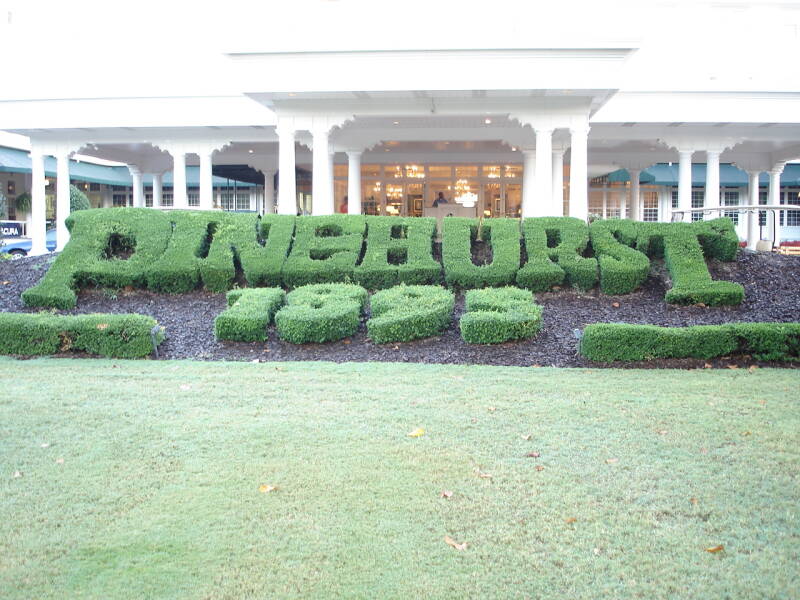
Twenty-one years is a long time between tee times.
My first trip to Pinehurst wasn't really a golf vacation. I was there to compete.
In September 2005, I was part of a team representing the Clubs of Lakeway in a tournament that brought together golfers from roughly 70 ClubCorp clubs from around the world. Pinehurst was then one of the crown jewels of ClubCorp, the company founded by Robert H. Dedman Sr.
We played Pinehurst Nos. 2, 5 and 8 in the event along with #4 for fun.
I was 44 years old, still chasing distance and probably evaluating golf courses differently than I do today. I also had no idea I was visiting Pinehurst at the end of an era.
Twenty-one years later, the reason for going back couldn't have been more different.
Our friends Sue and Keith invited Laurie and me to join them at Pinehurst. I had talked about the place over the years, and I wanted Laurie to experience it for herself.
There was no tournament this time. No team representing Lakeway. Nothing to win. Just four friends playing golf together at one of America's great golf destinations.
We had a wonderful time.
And somewhere along the way, I realized I wasn't simply revisiting Pinehurst. I was seeing it through very different eyes.
Because Pinehurst had changed considerably in 21 years. And so had I.
The ClubCorp Connection
Robert Dedman founded ClubCorp in 1957 and built it into an extraordinary collection of private clubs, golf courses and resorts. ClubCorp acquired Pinehurst in 1984, at a time when the historic resort had fallen on difficult times.
Under Dedman's ownership, Pinehurst began its return to prominence. The historic hotels were restored, golf again became central to the resort, and major championship golf eventually returned to Pinehurst No. 2.
That ClubCorp connection is what brought me there in 2005. Robert Dedman had died three years earlier, but the tournament he had established continued. Our team from Lakeway, Texas, suddenly found itself competing at Pinehurst against golfers representing ClubCorp properties from around the world.
For a golfer, that was a pretty special invitation. And the timing made it even better.
Michael Campbell had won the U.S. Open on No. 2 just a few months earlier. We were going to play the same course.
The Putter Boy
One of my favorite photographs from 2005 isn't of a golf hole at all. It's a picture of me standing beside the Putter Boy.
Back then, the little bronze golfer stood just outside the No. 2 pro shop. Created in 1912, he was originally designed as a sundial and eventually became one of Pinehurst's most recognizable symbols.
Naturally, I posed beside him.
Twenty-one years later, I did it again.
The Putter Boy hasn't aged a bit. I can't make quite the same claim.
But even he has moved.
Today, the Putter Boy stands prominently in the center of Pinehurst's 18-hole putting course. Instead of simply watching golfers come and go from the clubhouse, he's surrounded by people playing the game.
I rather like that. Pinehurst didn't discard its old symbol. It found a new way to make him part of the experience.
As I discovered during this return trip, that's a pretty good metaphor for Pinehurst itself.
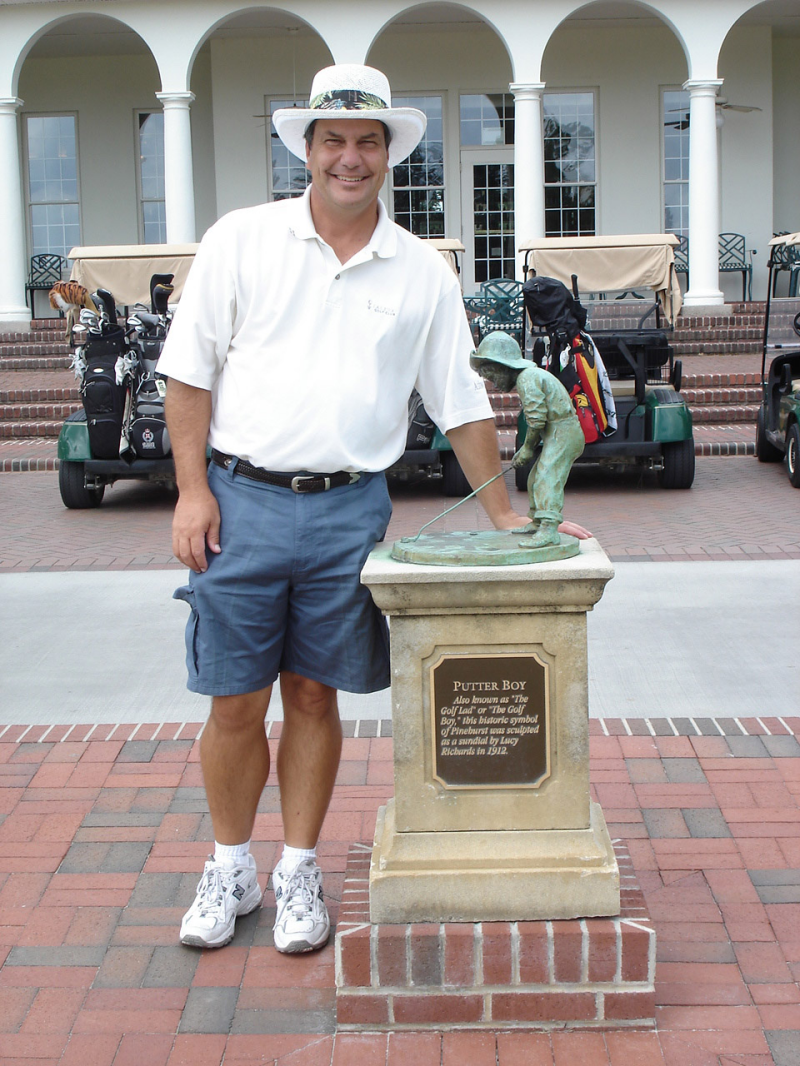
2005: The Putter Boy outside the No. 2 pro shop.
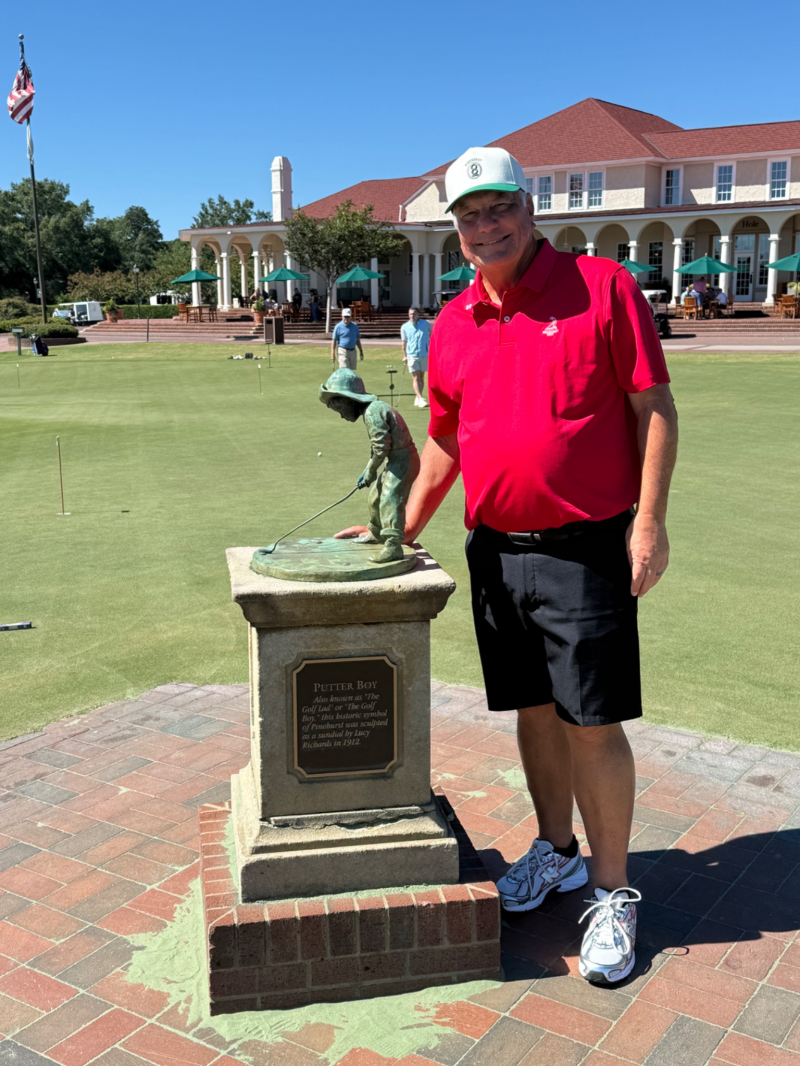
2026: Twenty-one years later, the Putter Boy now stands in the center of the 18-hole putting course.
When I played No. 2 in 2005, it was very much a parkland golf course.
The weather that day was perfect. The course was green and lush, with fairways bordered by maintained turf and thick rough. The Carolina pines framed the holes, and only a few months removed from Michael Campbell's U.S. Open victory, No. 2 still looked and played very much like the major-championship course I expected to see.
And I remember thinking it was a beast.
The rough was thick and deep. The greens were hard, fast and difficult to hold. Those famous Donald Ross crowned greens could turn a slightly imperfect approach into a considerably more difficult next shot. Miss in the wrong place and a chip could roll back to your feet. Hit it a little too hard and you could watch helplessly as the ball crossed the green and disappeared off the other side.
Twenty-one years later, I encountered a very different No. 2.
This time there was wind and rain, and instead of the lush parkland course I remembered, No. 2 felt almost like a sandy links.
The transformation by Bill Coore and Ben Crenshaw had removed much of the maintained rough and replaced it with exposed sand, pine straw, wiregrass and irregular native areas. Add the wind and rain we encountered, and at times it felt much closer to some of the links golf Laurie and I have played overseas than the Pinehurst No. 2 I remembered from 2005.
One of my photographs from this trip captures the difference perfectly. My ball is sitting on sandy ground among clumps of wiregrass.
In 2005, a similarly wayward shot probably would have been buried in thick Bermuda rough. In 2026, I might walk up to that same miss and find my ball sitting perfectly on the sand with an unobstructed shot at the green. Or I might find it six inches farther away, nestled against a clump of wiregrass with almost no shot at all.
Two balls five feet apart can present completely different problems.
I like that. There's an element of uncertainty to it - a little randomness and maybe even a little luck. Golf doesn't always need another four inches of perfectly manicured rough. Sometimes it needs a little chaos.
So which version of Pinehurst No. 2 was harder? I'm not sure.
In 2005, the thick rough, firm greens and perfect weather presented one kind of challenge. In 2026, sand, wiregrass, wind and rain presented an entirely different one.
Both ways, it was a beast.
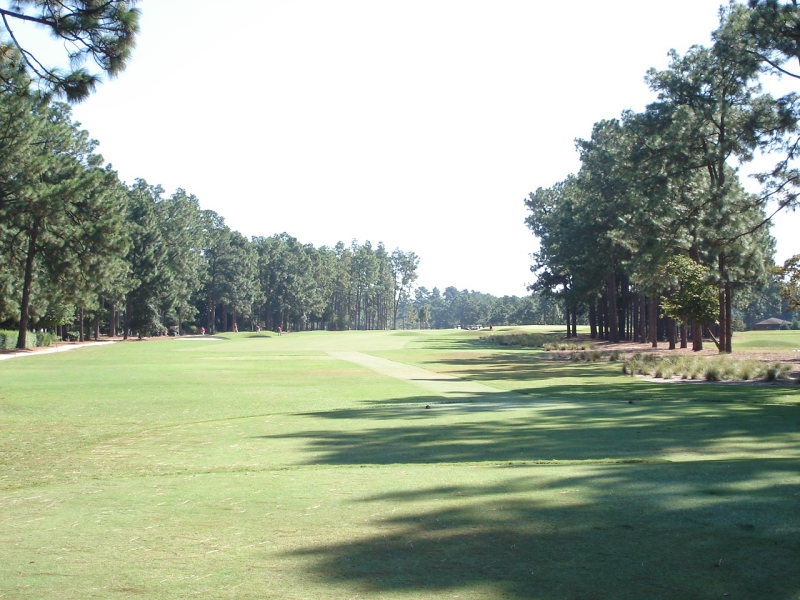
The first tee shot on Pinehurst No. 2, 2005 - one of the places that stayed in my memory for 21 years.
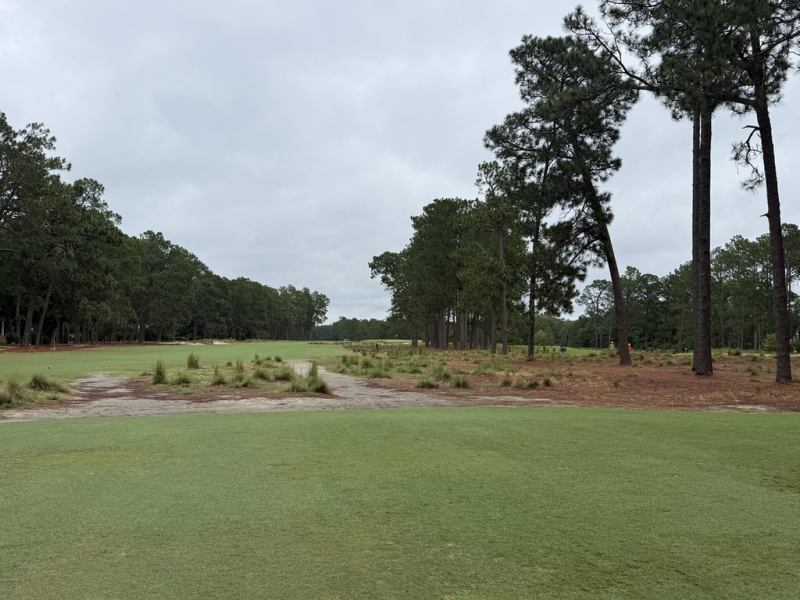
2026: The first hole of No. 2 - sand, wiregrass and native areas now frame the fairway.
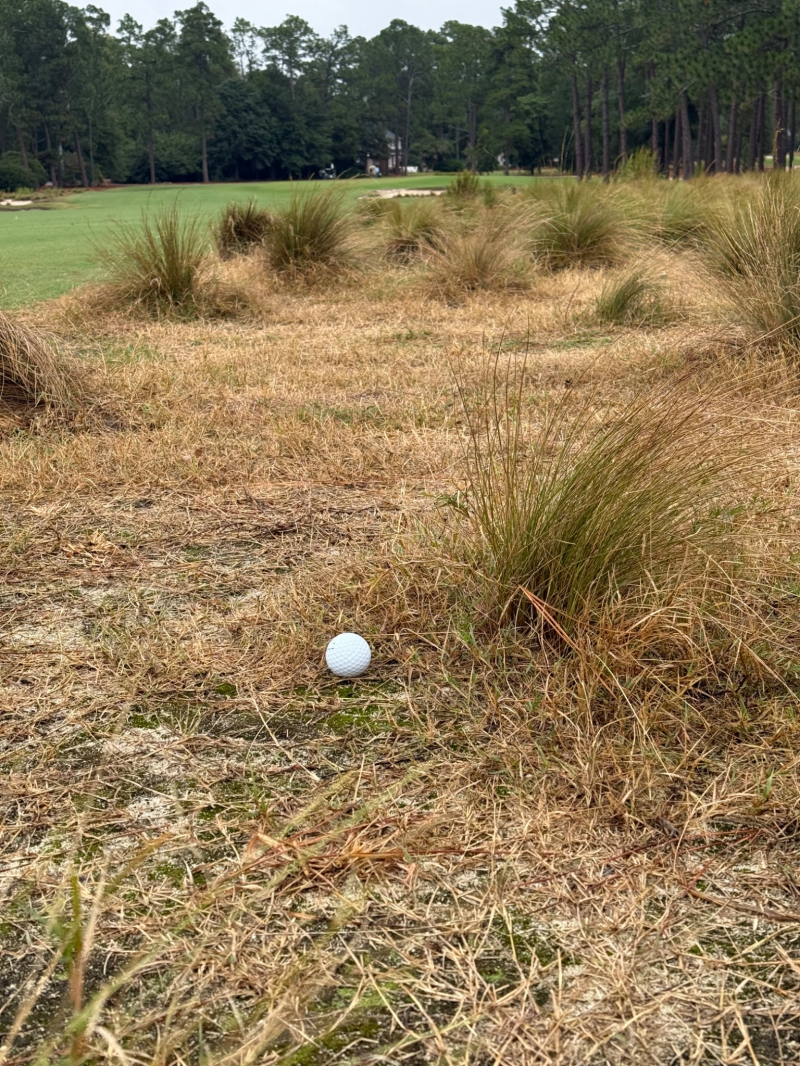
2026 detail: A miss can leave a clean sandy lie - or finish against a clump of wiregrass only inches away.
Three Old Friends and Two New Ones
In 2005, we played Pinehurst Nos. 2, 4, 5 and 8.
Twenty-one years later, Laurie, Sue, Keith and I played Nos. 2, 4, 7, 8 and 10.
That meant three return visits - to Nos. 2, 4 and 8 - and two completely new Pinehurst experiences for me.
No. 7 was one of those, and it turned out to be Laurie's favorite course of the trip.
The other was No. 10, Pinehurst's newest course, designed by Tom Doak. It didn't exist when I made that first trip in 2005, so playing it provided perhaps the clearest reminder that Pinehurst isn't simply preserving its past. It is still creating new golf.
But my favorite? No. 4. Again.
No. 4 had been my favorite Pinehurst course in 2005, and I wondered whether that opinion would survive 21 years.
After all, I've played hundreds of courses since then. My tastes have changed. I've developed a much greater appreciation for courses that use natural terrain, interesting angles and unpredictable bounces rather than simply relying on length and difficulty.
Yet after 21 years, I ended up right where I started. No. 4 was still my favorite.
There's something reassuring about discovering that not everything you remember fondly was improved by memory. Sometimes you really did love it for a reason.
Two Courses That Weren’t There Before
No. 10 wasn’t the only Pinehurst course that didn’t exist when I visited in 2005.
The Cradle opened in 2017, a nine-hole short course sitting just south of the croquet fields near the pro shop for Nos. 2, 4 and 5. The longest hole is only 122 yards, and Laurie and I played the entire thing in about 45 minutes.
It may be the purest fun at Pinehurst.
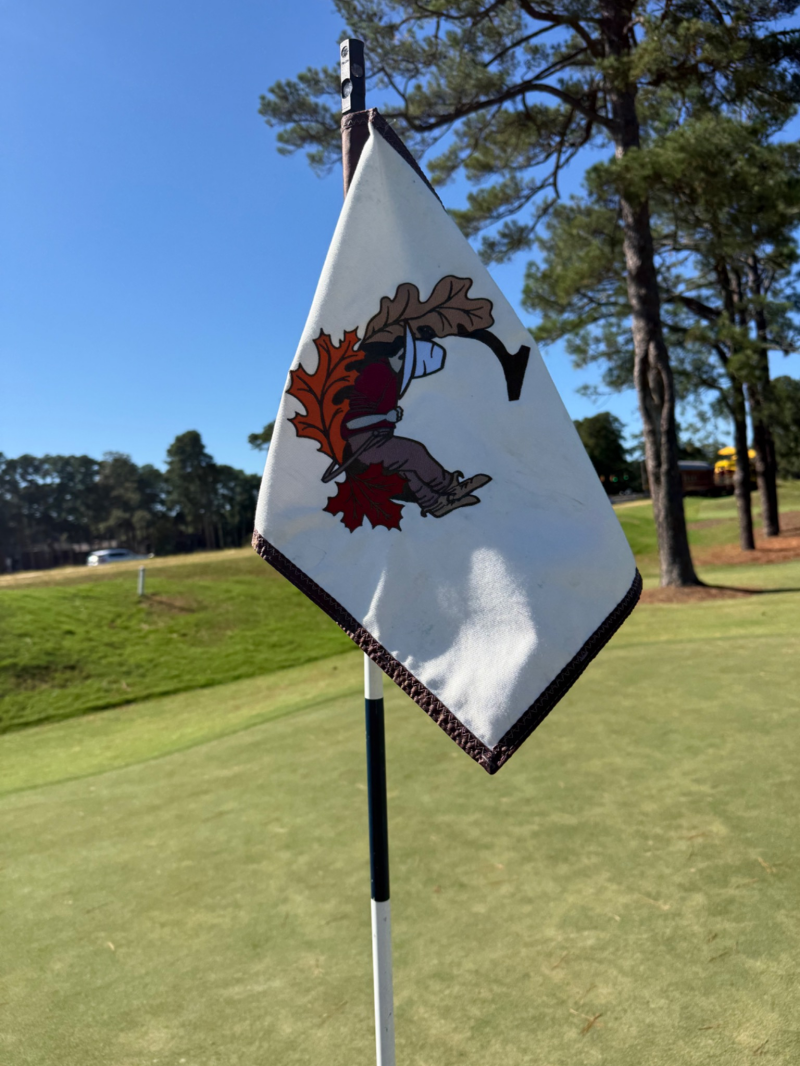
The Cradle’s flagstick gives you a pretty good idea of the atmosphere—Pinehurst history with a sense of humor.
At the starter shack we met Ed, who has been at Pinehurst for more than 40 years. That means he had already been there for roughly two decades when I made my first visit in 2005.
Laurie gave him a hug.
Ed let us onto the course.
I’m not sure that’s the official Pinehurst check-in procedure, but it worked beautifully for us.
The Cradle barely resembles conventional resort golf. Many people play it barefoot. Music plays throughout the course. A bar sits in the middle of the action, between holes 3 and 4 on one side and 8 and 9 on the other. People gather around the fire pit with drinks in their hands and watch golfers fire short irons and wedges at the nearby greens.
Hit one close and you might get a cheer from complete strangers.
More than 60,000 rounds a year are played on those nine tiny holes, and after spending 45 minutes there, I understand why.
Nobody seemed particularly concerned about a scorecard. Nobody was grinding over a three-footer. Nobody was worrying about pace of play. They were just playing golf and having fun.
No. 10 and the Cradle represent two very different ways Pinehurst has grown during the 21 years I was away. No. 10 is serious golf—a modern Tom Doak design intended to stand alongside the resort’s famous championship courses. The Cradle is almost the opposite: nine little holes, music, drinks, bare feet and applause from strangers.
And Pinehurst has room for both.
The Pinehurst I visited in 2005 was a place where I had come to compete. No. 2 had just hosted a U.S. Open. Golf there felt important, historic and, at times, pretty serious.
All of that still exists. But now there’s also a place where you can kick off your shoes, grab a drink, listen to music and play nine holes with nothing longer than 122 yards while strangers cheer a good wedge shot.
Pinehurst didn’t become less serious about golf. It simply figured out that golf doesn’t always have to be serious.
Maybe that’s another reason I enjoyed Pinehurst more at 65 than I did at 44.
Pinehurst Added Some History While I Was Gone
When I visited in 2005, one of the most recognizable spots at the resort was already the statue of Payne Stewart celebrating the putt that won the 1999 U.S. Open.
Naturally, my teammate, Bill Bunte, and I tried to recreate Stewart's famous pose. We weren't particularly graceful, but we got the picture.
Twenty-one years later, Laurie and I stood beside the same statue. There was really only one thing to do. We recreated it again.
Some traditions deserve to be preserved.
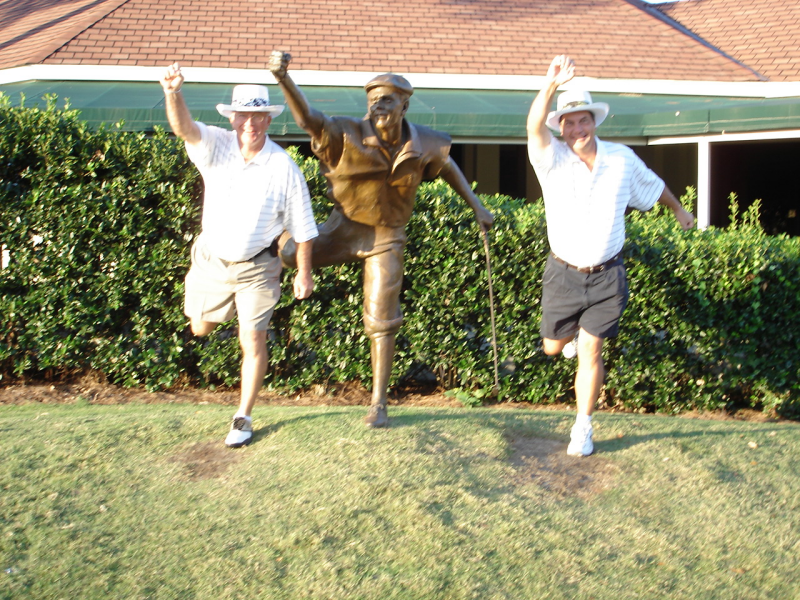
2005: Recreating Payne Stewart's famous celebration.
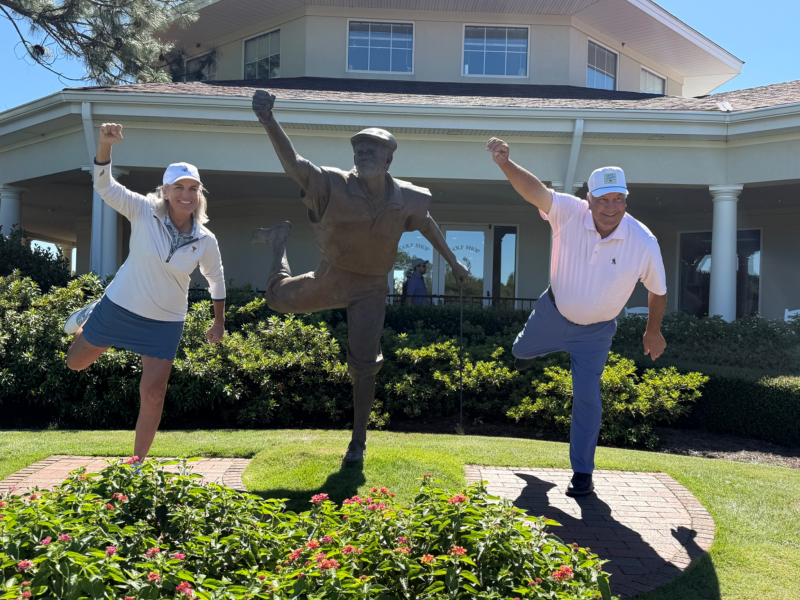
2026: Laurie and I couldn't resist doing it again.
But Pinehurst now has another famous U.S. Open moment.
On the 18th hole of No. 2, a plaque marks the spot in the bunker from which Bryson DeChambeau played his extraordinary 55-yard recovery shot to four feet on the final hole of the 2024 U.S. Open. The plaque calls it "The Shot of My Life."
That's one of the wonderful things about Pinehurst. Golf history here isn't something locked behind glass. You can stand where it happened. You can play the hole. You can even try the shot.
Although in Bryson's case, I think I'd rather just take the picture.
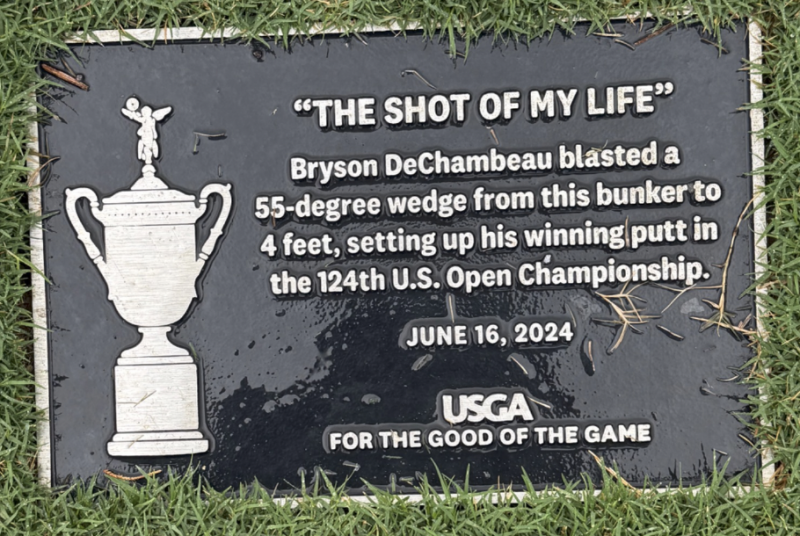
2026: The plaque marking Bryson DeChambeau's "Shot of My Life" on the 18th at No. 2
And Then I Found Mr. Dedman
There was one other addition that caught my attention.
Near the statues honoring the people who shaped Pinehurst, including the Tufts family and Donald Ross, now stands a statue of Robert Dedman Sr. It wasn't there when I visited in 2005.
That one meant something to me.
In 2005, Dedman was part of the reason I was at Pinehurst in the first place. I belonged to a ClubCorp club in Lakeway, and the tournament he had established had given an amateur golfer from Texas the opportunity to compete at Pinehurst.
A little more than a year after my visit, the Dedman family sold the larger ClubCorp portfolio. But they kept Pinehurst, maintaining the family's connection to the resort.
Twenty-one years later, I returned and found Robert Dedman memorialized alongside the people whose names are inseparable from Pinehurst.
There was a nice symmetry to that.
In 2005, I came to Pinehurst because of the golf organization he had built. In 2026, I came back and found him standing among the people who helped build Pinehurst.
The Course Changed. So Did I.
Pinehurst wasn't the only thing that changed during those 21 years. I did, too.
I was 44 during that first trip. I was 65 when I returned.
During the years in between, I've played hundreds more golf courses across the United States and around the world. I've played old links in Scotland, England and Northern Ireland. I've played courses above the Pacific in New Zealand. I've played mountain golf, desert golf, parkland golf, resort golf and plenty of wonderful courses that will never appear on anybody's Top 100 list.
All of that changes what you value.
At 44, I was probably more impressed by difficulty, conditioning and reputation. At 65, I'm less impressed by perfection. I'm more interested in personality.
Give me an odd bounce. Give me a rumpled fairway. Give me a strange angle into a green. Give me a lie that makes me scratch my head and wonder what on earth I'm supposed to do next.
Most of all, give me a golf course that I will remember.
In 2005, I mostly remembered Pinehurst No. 2 for being brutally difficult. In 2026, I found myself much more interested in why it was difficult.
That's a very different way of looking at a golf course.
Twenty-One Years Later
Some things haven't changed.
The Carolina pines are still there. The sandy soil is still there. Those maddening Donald Ross greens are certainly still there. Payne Stewart is still frozen in celebration. The Putter Boy is still putting away.
And, apparently, No. 4 is still my favorite.
But Pinehurst hasn't preserved its history by freezing the place in time. It has continued adding to it.
No. 2 changed dramatically by going backward - removing decades of conventional golf-course grooming to recover more of the character Donald Ross intended.
The Putter Boy moved from outside the pro shop to the middle of a putting course. Robert Dedman joined Tufts and Ross in bronze. Bryson DeChambeau joined Payne Stewart in Pinehurst lore. No. 10 added a new Tom Doak course to the resort, while the Cradle added nine tiny holes where music plays, people go barefoot and strangers cheer good wedge shots.
I changed, too.
In 2005, I came to Pinehurst to compete.
In 2026, I came back for a very different reason.
I wanted to show Pinehurst to Laurie. Sue and Keith invited us to join them, and four friends spent several wonderful days playing golf together.
Maybe that's the biggest change of all.
The score still matters. I still want to hit a good drive, knock an iron close and make the putt. But increasingly, the scorecard isn't the part I remember.
I remember the places. I remember the people I played with. I remember the great shots, the terrible shots and the ridiculous lies.
And I remember standing beside a little bronze Putter Boy in 2005 and returning to stand beside him again 21 years later.
Looking at those two photographs side by side, I see the same golfer - but not quite the same person.
The first one came to Pinehurst to compete. The second came back to share it.
I think I like the second reason better.
Add comment
Comments