Greenies, Cry Babies and the Betting Games We Play
The largest prize I have ever won on a golf course was one billion dollars.
Before anyone contacts the IRS, I should explain that it was one billion Zimbabwean dollars. I won the note for closest to the pin at a charity event at Barton Creek's Canyons course several years ago. It may not have changed my retirement plans, but it remains the most impressive-looking prize in my golf collection.

My largest golf prize: one billion Zimbabwean dollars for closest to the pin at Barton Creek’s Canyons course.
That prize captures something important about golf betting. The amount is rarely the point. A small wager simply makes a shot matter a little more. A five-footer that would otherwise be conceded becomes a test of character. A routine approach becomes a Greenie opportunity. And a round that has gone completely off the rails can become interesting again with one good swing.
Our games are usually small enough not to spoil a friendship, but large enough to make us pay attention. They also come with their own vocabulary, partnerships and mathematics. To an outsider, a conversation about Hogans, Morettis, Wolves and Cry Babies may sound like a meeting that should be taking place somewhere other than a golf course.
COD and the Art of Changing Partners
One of our staples is COD: Carts, Others and Drivers. It is our version of Sixes, dividing an eighteen-hole round into three six-hole matches and making sure everyone in a foursome eventually has a chance to blame everyone else.
- Holes 1 through 6 are Carts. The two players riding in the same cart are partners.
- Holes 7 through 12 are Others. Each driver plays with the passenger in the other cart.
- Holes 13 through 18 are Drivers. The two cart drivers play against the two passengers.
COD determines the partnerships, not the scoring. Depending on the skill levels in the group, we have played one best ball, combined score, match play or three points per hole for low, high and total. In Low High Total, the lower individual score earns one point, the lower of the two higher scores earns another, and the lower team total earns the third. If Team A makes 4 and 6 while Team B makes 5 and 5, Team A wins low, Team B wins high and the total is tied.
By the end, everyone has partnered with everyone else—and usually has a legitimate complaint about each of them.

Four players provide plenty of possibilities: COD, Left Right Center, 16 Point — or whatever game can be agreed upon before the first tee shot is in the air.
Nine and 16 Point
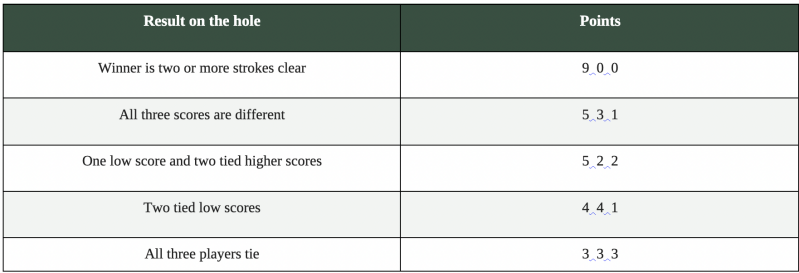
Nine Point is built for three players, while 16 Point applies the same idea to a foursome. Every hole distributes a fixed number of points. The better your score, the larger your share. The system keeps all players involved, but it can punish the player who repeatedly finishes last.
Nine Point Scoring
Sixteen Point Scoring
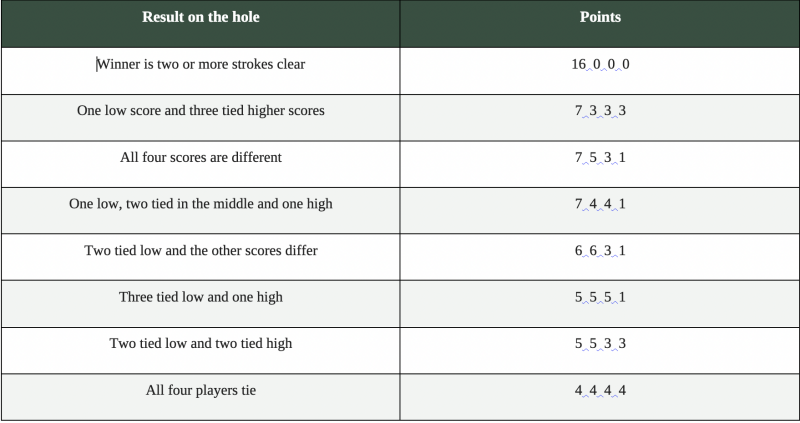
The arithmetic is easy. The danger is cumulative. In 16 Point, one bad hole is manageable. Being the high man on four or five holes is a financial strategy best discussed with your accountant.
Left > Right > Center
Left Right Center is a four-player game in which partnerships are determined by tee-shot position. The player with the honor hits first and that ball becomes the center reference. On odd-numbered holes, the action is on the left. If two balls finish left of the honor ball, those two players are partners. If only one ball finishes left, that player partners with the honor player. On even-numbered holes, the same procedure applies to the right side.
If all three other balls finish on the same side of the honor ball, the player with the honor goes alone against the other three. One low ball decides the points. Sometimes the loneliest place on the golf course is the center of the fairway.
Wolf
There may be as many versions of Wolf as there are golf groups. We usually play it with a fivesome, which our club allows. We toss marked balls to establish the order, use one best ball on each hole, and rotate the Wolf through the first fifteen holes.
The Wolf can declare Lone Wolf before hitting, play one against four and quadruple the bet. After hitting, the Wolf may choose a partner immediately after any player’s tee shot and play two against three. If the Wolf watches everyone hit and then decides to go alone, the bet doubles. A selected partner can even dump the Wolf and go alone, which also doubles the bet. Wolf is the rare golf game in which playing well can make you a target.

Five players, one rotating Wolf and three closing Cry Baby holes. What could possibly go wrong?
Then come the last three holes. After fifteen, the player who is down the most points becomes the Cry Baby on No. 16 and can set the value of the hole up to half the amount he is behind. The Cry Baby is recalculated after No. 16 and again after No. 17, so the player in the deepest hole gets the next chance to recover.
We have watched someone play beautifully for fifteen holes, build a comfortable lead, get selected as the Cry Baby’s partner and lose every point while the Cry Baby falls even farther behind. That is not bad luck. That is Wolf.
The Furry Dice Version
We have also played a less expensive version using an oversized furry die. The player whose turn it is, rolls before the tee shots. A 1 forces a Lone Wolf and doubles the bet. A 2 is standard Wolf, allowing the player to choose a partner after each tee shot. A 3, 4 or 5 assigns the corresponding player as the partner. A 6 allows the Wolf to watch everyone hit and then choose. There is no dumping, but the Cry Baby still appears for the final three holes. Chance controls more of the partnerships, and the missing multipliers generally keep the damage down.
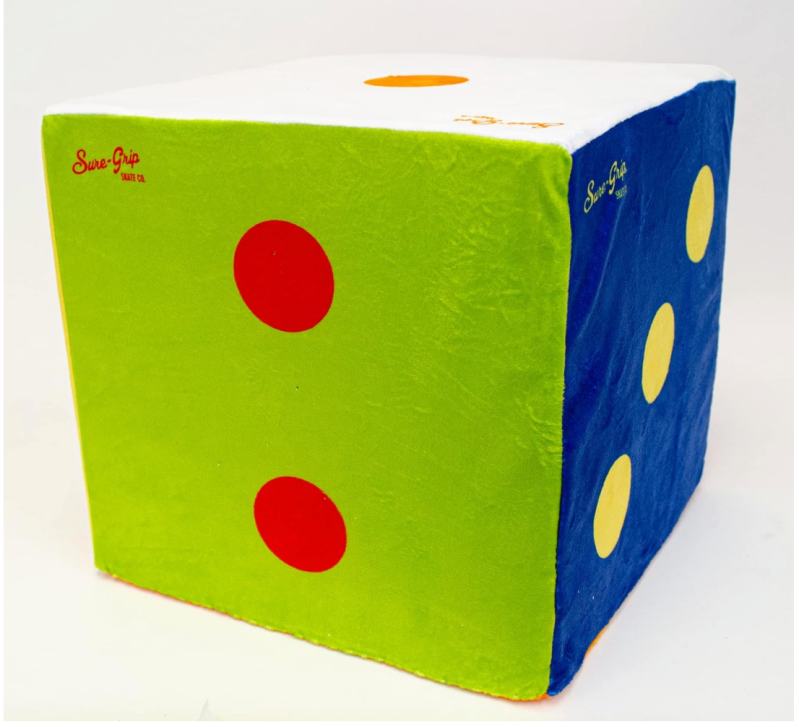
Sometimes we make our own decisions. Sometimes we let a giant furry die choose our partner.
Forty Balls
Forty Balls is one of our best multi-team formats because it combines golf with resource management. Every team must submit exactly forty individual hole scores. A foursome selects forty of its seventy-two scores; a threesome selects forty of fifty-four. The lowest total of the forty chosen scores wins.
The catch is that the decision is made immediately after each hole. A team may keep zero, one, several or all of its scores, but once the choice is made, it is locked. The game can be played gross or net. We usually balance the teams as evenly as possible and play gross.
Four pars on the first hole? Keeping all four sounds sensible. One par, two bogeys and a double? Now the conversation begins. The par is easy. Do you bank one of the bogeys, save capacity for later, or keep more because at least you know what you have? If a foursome reaches the 16th tee with only twenty-eight scores selected, there is no longer a decision: all twelve remaining scores count.
Most golf bets ask, “What did you make?” Forty Balls adds a second question: “Are we willing to live with it?” It rewards good shots, good planning and honest assessment—and severely punishes optimism.
Greenies, Hogans, Morettis and Birdies
When we have two teams, we often play a match in which two best balls count on the par 4s and par 5s, while three best scores count on the par 3s. The match includes automatic two-down presses, so no team is ever very far from a fresh start. On top of that match sit the bonus points that give the game its personality.
-
Greenie: one point for the closest qualifying shot to the hole on every hole.
-
Hogan: one point when every player on the team hits the green in regulation.
-
Moretti: one point when every player on the team makes par or better.
-
Birdie: one point for each birdie.
-
Eagle: two points for each eagle.
The Greenie has an important condition: the player must finish without a three-putt. If you three-putt, you pick up the closest-to-the-pin marker and the shot does not count. If the first team’s player three-putts, the second team still has an opening. If the second team beats the first marker and then three-putts, neither team gets the point; the first team does not inherit it back. A Greenie is not earned when the ball reaches the green. It is earned when the ball reaches the bottom of the cup.
A Hogan is named for Ben Hogan and his reputation for precise iron play and greens in regulation. In today’s generation, we might call it a Scheffler because nobody hits irons better than Scottie Scheffler. A Moretti comes from our friend Bill Moretti and his book, Turn 3 Shots Into 2. The idea is simple: find a way to make par.
The distinction matters. A Hogan rewards reaching the green. A Moretti rewards finishing the job. Our group has produced plenty of Hogans that died somewhere between the first putt and the bottom of the cup.
The points can pile up quickly. On our short par-5 14th at Yaupon, all four players on one team once hit the green in regulation and made birdie, and the team also won closest to the pin. That produced one Greenie, one Hogan, one Moretti and four birdie points—seven points on a single hole. It has happened, which means everyone believes it can happen again.

Two teams at the Yaupon course. An automatic two-down match, Greenies, Hogans, Morettis, birdies and eagles begin, the scorecard tells only part of the story.
The Deuce Club
One game crosses every format we play: the Deuce Club. It applies during COD, Wolf, team matches and casual rounds. It even comes into play when I am playing as a twosome, or when I am playing with Laurie and her friends, who generally have little interest in our more elaborate betting games.
The rule is wonderfully simple. Any time a member makes a 2 on any hole—a par 3, par 4 or par 5—each Deuce Club member in the group owes that player two dollars. A 2 on a par 3 is the familiar birdie. A 2 on a par 4 is an eagle. A 2 on a par 5 is the sort of story that should probably be verified by witnesses, but it still pays the same two dollars.
Joining is slightly more complicated. You cannot simply announce that you would like to become a member. You must first make a 2 while playing with at least one existing member. If you qualify and choose to join, you pay each member in your group two dollars as an initiation fee. From that moment forward, every 2 you make is rewarded by the other members playing with you—and every 2 they make costs you two dollars.
We now have about forty members at our club, along with members in Maine, Iowa, Colorado and Florida. The Deuce Club travels well because it needs no scorecard system, no teams and no explanation before the first tee. Members simply recognize one another and settle up whenever a 2 appears.
There is one final rule: you can never leave. Once you join the Deuce Club, you pay every time you are playing with a member who makes a 2. Membership is for life—or at least for as long as anyone remembers that you joined.
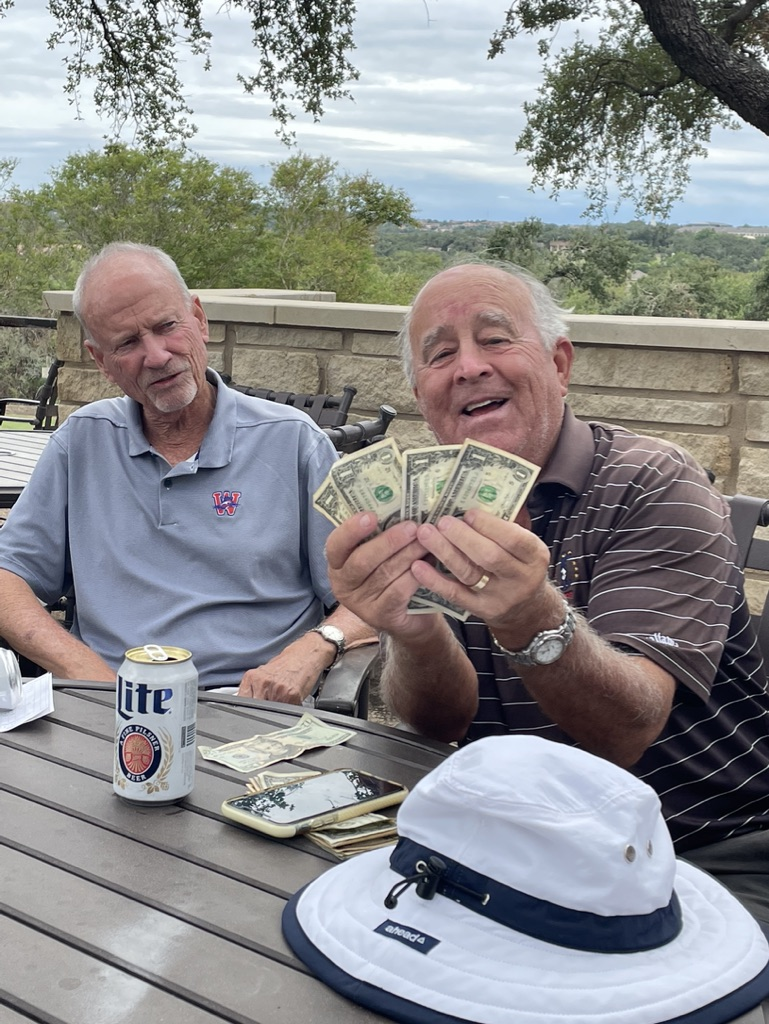
John is proud of his deuce money...
Why We Keep Playing Them
Golf betting has never required much money to do its job. The wagers are rarely large enough to change anyone’s life. They are just large enough to change how a golfer feels standing over a five-foot putt.
The games also keep more of the round alive. If your individual score is gone by the seventh hole, your partner may still need you. If the match is getting away, a press can reopen it. If the first fifteen holes have been a disaster, the Cry Baby gives you one more chance. And in Forty Balls, even the team meeting after a double bogey can become part of the entertainment.
Mostly, though, the games create stories. Nobody remembers every routine par, but we remember the billion-dollar closest-to-the-pin prize, the seven-point hole, the Wolf who chose the wrong partner and the team that arrived at No. 16 needing twelve scores. Those memories are why a little something on the side has become part of the game for us.
Place your bets.
Add comment
Comments